The first conversation is complimentary and obligation-free → Book a 30-minute call

Before you buy an AI tool, check the process it will run on. A practical guide for Australian business owners on fixing workflows before automating them.
When business owners talk to me about AI, the conversation usually opens with the same question: which tool should we buy?
I understand why. New products launch every week, and the pressure to keep up is real. From a quality management point of view, though, it’s the second question to ask. The first is which process you’re trying to improve, and whether you understand how it works today.
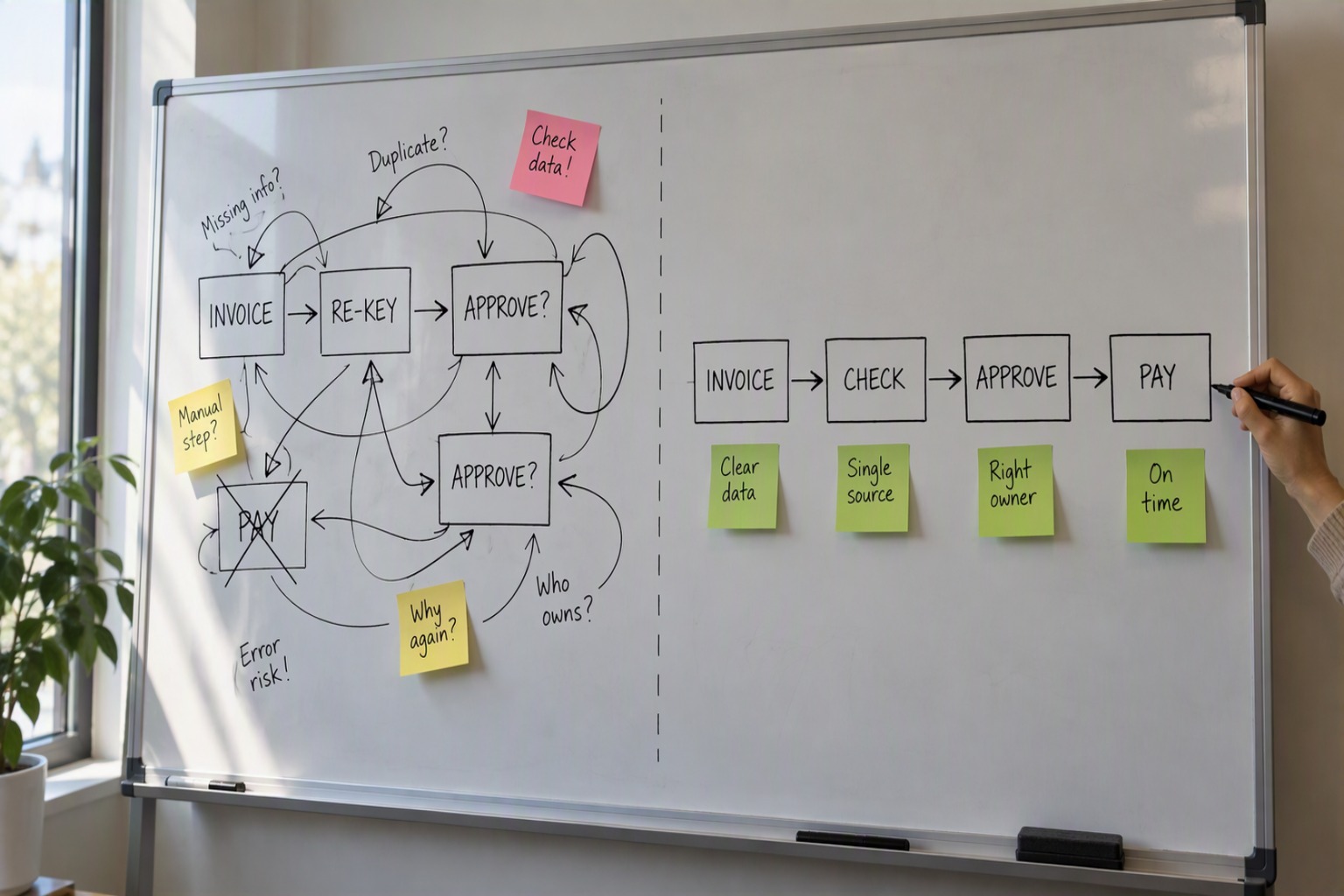
Picture an accounts team where supplier invoices pass between several people before anyone pays them. Some are entered into the finance system and then typed again into a spreadsheet the manager prefers. Approvals sit in someone’s inbox for days. When a supplier rings to chase payment, nobody is quite sure where their invoice has got to.
Now add an AI tool that reads invoices and routes them automatically. The reading gets quicker, and everything else stays as it was. The invoice still goes to the wrong approver, the spreadsheet still needs updating, and the supplier still can’t get a straight answer. The business has paid to make a confused process run faster.
Lean thinking has a name for steps that add nothing for the customer: waste. Automation keeps that waste and makes it harder to see, because it now happens inside a system rather than on someone’s desk.
In a business of ten or fifteen people, goodwill covers a lot of operational gaps. People know who to ask, problems get sorted in the corridor, and one experienced person remembers how the awkward jobs are done.
In many businesses, somewhere past twenty or thirty staff, that stops working. Teams develop their own versions of the same task. Information ends up spread across inboxes, shared drives and people’s memories. Decisions wait for the two or three people who know how things really work, and leaders spend more of each week sorting out problems that shouldn’t have reached them.
Nothing went wrong overnight. Growth removed the informal workarounds that were holding things together, and the gaps became visible.
This is often when owners start looking seriously at AI and automation. The pain is real and the tools promise relief, so it’s an understandable move. It’s also the point at which automating the existing mess is most tempting.
None of this is an argument against AI. Applied to the right work, it saves real time. It tends to do well at:
These tasks share a predictable shape. The inputs are known, the expected output is clear, and exceptions are rare enough for a person to handle.
AI has a much harder time when the underlying problem is about structure and responsibility.
Unclear ownership. If nobody owns a process, automation won’t settle the question. The confusion moves into the system, where it’s harder to challenge.
Inconsistent methods. When several people do the same task in different ways, there’s no single process for a tool to support, so the results stay inconsistent.
Knowledge held in people’s heads. AI can only work with what has been written down or captured somewhere. The know-how that lives with your longest-serving staff member is invisible to it.
Poor hand-offs between teams. If two teams already struggle to pass work cleanly to each other, putting a tool between them often creates one more place for things to go missing.
Consider a professional services firm that wants faster client onboarding. It introduces online forms, automated welcome emails and AI-drafted engagement letters. Months later, new clients are still waiting weeks to get started.
When someone finally maps the process, the cause is plain. Three partners each believe they’re the one who approves new clients. Client details are held in two systems that don’t talk to each other, and conflict checks happen whenever someone remembers. The forms and emails are working exactly as designed; the process underneath them isn’t.
Once the firm agrees who approves what, picks one system as the source of truth and fixes the order of steps, the same tools start delivering what they were bought for.
Before a process goes anywhere near an automation tool, you should be able to answer these with confidence:
The last question matters more with AI than with older forms of automation, because AI tools can produce confident answers that are simply wrong. Any step that relies on AI needs a named person reviewing its output wherever an error would be costly.
If you can’t answer all five, that process isn’t ready to automate yet. That’s useful to know, and much cheaper to learn before the software is bought than after.
The approach I use has four steps. It draws on Deming’s Plan-Do-Check-Act (PDCA) cycle, which has guided continuous improvement for decades.
Map. Walk the process with the people who do the work and record what actually happens, workarounds included. The written procedure is a useful starting point, but expect reality to differ from it.
Fix. Remove steps that add nothing, simplify hand-offs and give every stage a clear owner. Then standardise the method so the work is done the same way each time.
Automate. Apply AI and automation to the stable, repetitive steps that remain, with human review built in where mistakes would be expensive.
Control. Measure whether the change is working, keep an eye on what the tool produces, and adjust as you go. Processes that nobody monitors tend to drift back to old habits.
If you know PDCA, you’ll see how the two relate. Mapping and deciding what to fix is the planning, making the changes and automating them is the doing, and Control is where you check the results and act on what you find. Like PDCA, it’s a loop: once one process is stable, you move on to the next.
AI is a genuine opportunity for Australian businesses, and I expect it to become part of how most of them operate. The ones that get the most from it will be the ones that understood their own processes first.
So before your next software demo, choose one process that frustrates your team and walk it from start to finish with the people who do it. An afternoon spent doing that will tell you more than any product brochure.
If you’d like a second pair of eyes on that process, I’m happy to talk it through.
About the author
Juditha Agarwal is the founder of Foundex, a Melbourne-based operational consultancy. With a background in Total Quality Management, she helps growing Australian businesses understand and improve how their work flows before they invest in automation.
Header image created with Microsoft Copilot.